An event tracking plan is an agreement about meaning. It tells a designer what behavior is being measured, a developer when to record it, an analyst how to interpret it, and a reviewer which information is permitted to leave the page. Without that agreement, several teams can use the same event name while imagining different things.
The plan does not need to be elaborate. A clear document with a small number of events is a better starting point than an impressive catalog nobody maintains. This guide uses a hypothetical documentation website to show how purpose, naming, properties, triggers, and quality checks can fit together.
Begin with the decision, not the listener
Write the decision the event should support. “Should we make the setup guide easier to find?” is a reasonable starting question. It suggests measuring whether visitors reach the guide from relevant pages. “Record every click” does not identify an equivalent decision.
Define the intended outcome in observable terms. Reaching the guide, opening an example, and copying a snippet represent different actions. None automatically proves that the visitor successfully configured a product. Keep that distinction in the plan so a report does not claim more than the implementation can observe.
Assign an owner to the question. If no one can explain what they will do with the event, pause its addition. The visitor insights overview can help connect a proposed signal to a concrete content or navigation question.
Choose a stable vocabulary
Use event names that describe the action independently of its current visual label. A controlled name such as “guide_opened” is easier to maintain than a name copied from a button whose wording changes in an experiment.
When working within an existing analytics product, inspect its documented event model before inventing your own. Google’s recommended events documentation provides defined event names and parameters for particular use cases. Those definitions are product-specific; do not assume another platform interprets an identically named event in the same way.
For a custom plan, write down your naming convention and stick to it. A short, understandable vocabulary is preferable to many synonyms for nearly identical actions. Keep the display labels in a report separate from the stable event identifiers used in collection.
Specify exactly when an event fires
An event definition needs a trigger, not merely a name. Does “guide_opened” fire when the visitor activates a link, when navigation completes, or when the guide becomes visible? Those moments may differ, and the choice changes the interpretation of the count.
Describe the trigger in language that can become a test. For example, “Record once when the approved guide route becomes the active page after navigation” is more precise than “Track guide engagement.” Decide how reloads and repeated visits should be handled.
Separate attempts from confirmed outcomes
A button activation may represent an attempt. A successful response or completed state may represent an outcome. Use different events when the distinction matters. Do not call a contact-link click “message_sent” when the website cannot observe whether the visitor’s email application actually sent anything.
Create a property allowlist
For each event, list the permitted properties, their types, allowed values, and why they are needed. A guide event might include a controlled topic category and a placement label. Avoid accepting arbitrary properties simply because the collection library supports them.
Define what should happen when a property is missing or invalid. A test record should not silently acquire a misleading default that makes it look like a normal production observation. Decide whether the event should be rejected, flagged, or recorded with an explicit unknown value.
Keep personal details and free text out of general templates unless a specific, reviewed requirement justifies them. The privacy-first analytics guide explains how to connect collection boundaries to purpose. A readable allowlist makes that discussion concrete for both technical and nontechnical reviewers.
Decide how repeated actions are counted
A visitor may open the same disclosure several times, double-click a button, or return to a page. The plan should say whether those are separate events and how downstream reporting treats them.
Avoid using duplicate suppression to hide an unclear definition. First decide what one valid event represents. Then design any deduplication rule around that meaning. If a transport retries a payload, an event identifier can help distinguish a retry from a new user action in systems designed to support that behavior.
Keep event count separate from sessions or recognized users in the reporting dictionary. Ten events could come from ten different sessions or repeated behavior within one session. A chart should not casually label the total as “people” unless the collection and calculation support that interpretation.
Write the collection boundary explicitly
Document when the event is permitted to be collected and where it is sent. For an optional analytics implementation governed by a chosen permission state, include that state in the acceptance criteria. The trigger and the transport should not follow conflicting rules.
List the destination, expected payload, and any processing performed before the report. The plan should make it possible to answer where a field came from and why it appears in an export. Do not leave those decisions buried in an implementation file that only one teammate knows about.
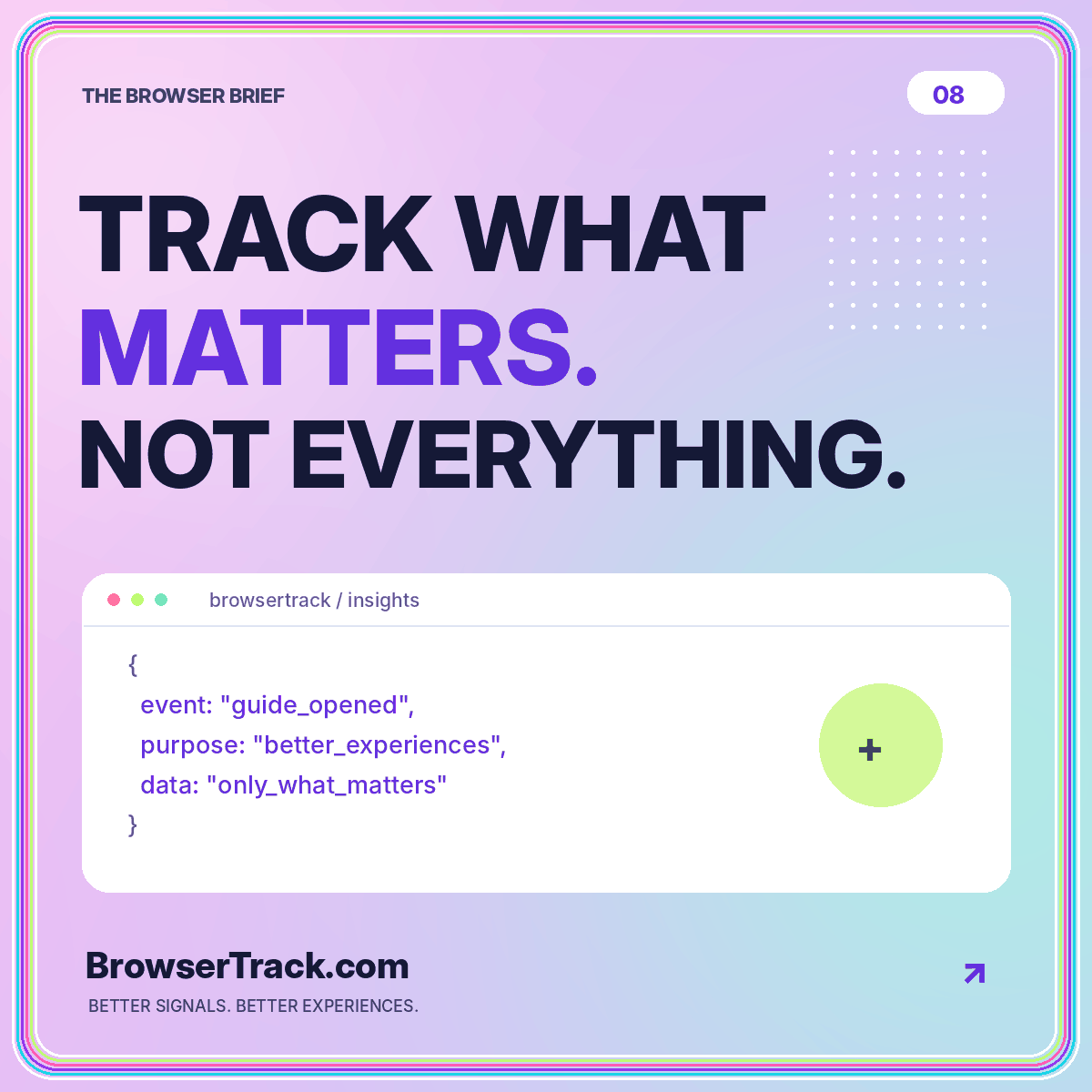
The event schema example illustrates a compact, synthetic record. It is a planning reference, not a live collection endpoint. Use it to discuss structure, then adapt the fields to the actual destination and responsibilities of your own system.
Test the event from action to report
Create a test case with a known action, expected event name, permitted properties, and expected count. Execute it in a controlled environment, inspect the outgoing record where appropriate, and confirm its downstream representation.
Include negative tests. An unrelated click should not fire the event. An unapproved property should not be forwarded. A permission state that disallows optional collection should not produce that optional event. These tests reveal boundary mistakes that a simple “I saw one event arrive” check will miss.
Check the report’s counting logic separately from transport success. A payload reaching a destination does not prove that the report groups or deduplicates it correctly. Record the outcome of each stage so a future regression can be located without repeating the entire investigation from the beginning.
Version definitions and retire unused events
When meaning changes, treat it as a measurement change. Renaming a display label is different from changing the trigger, unit, or included population. Document the effective date and explain whether old and new records can be compared directly.
Keep a changelog in the same place as the plan. Include the reason for each revision and the owner who reviewed it. Where a report depends on an old definition, update the report or make its limitation visible rather than silently mixing incompatible records.
Review unused events periodically. Retire the code, scheduled exports, and documentation together when an event no longer serves a current purpose. Leaving an obsolete listener in place creates maintenance work and collection that nobody can clearly justify.
Conclusion: make meaning the durable part
A maintainable tracking plan connects an event to a purpose, an observable trigger, a stable name, approved properties, and a testable counting rule. It also explains the collection boundary and how the record becomes a report.
Start with a few events that support real decisions. Review them with the people who design, implement, interpret, and govern the system. Then maintain the definitions as carefully as the code. Clear meaning is what allows a small event catalog to remain useful as the website and the team evolve.