A traffic-source report is only as clear as the labels that reach it. One team may call an email campaign “spring-launch,” another “SpringLaunch,” and a third “launch-email-final.” Even when the links work perfectly, the report can become a collection of names that no longer describe the same initiative consistently.
A durable UTM system is less about generating a long URL and more about maintaining a shared vocabulary. This guide develops a small naming register, a practical link-review process, and an interpretation checklist. The examples use invented campaign names and illustrate a workflow rather than real acquisition results.
Understand the pieces of a campaign label
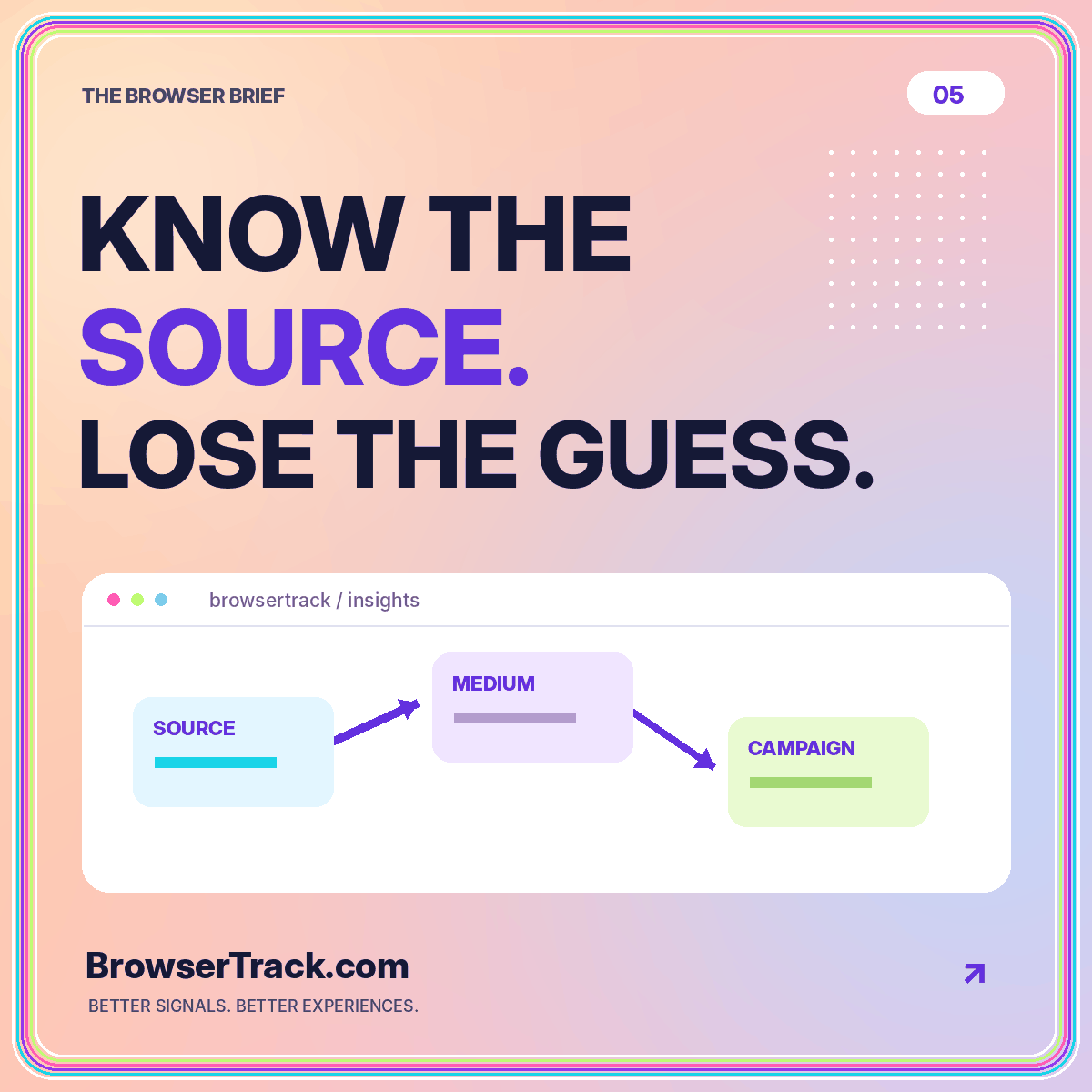
Google’s campaign URL documentation describes UTM parameters for identifying source, medium, and campaign, with optional parameters for additional detail. It also notes that parameter values are case-sensitive. These parameters are labels attached to a link; the receiving analytics setup determines how they appear in its reports.
For an illustrative newsletter link, the source could identify the newsletter, the medium could identify email, and the campaign could identify the initiative. A content label could distinguish a header link from a text link when that distinction is useful.
Do not confuse labels with proof of influence. A recorded campaign value shows the attribution information your measurement captured. It does not establish that the campaign alone caused a subsequent outcome or that unmeasured exposures played no role.
Build a naming register before a link builder
Create a small document containing approved source values, medium values, campaign names, and the person responsible for each initiative. For a small website, a plain text register can be enough. The important feature is that everyone refers to the same list.
Choose a predictable style for new names. For example, your team might use lowercase words separated by hyphens and avoid unnecessary punctuation. That is an internal convention, not a guarantee that every reporting tool will group the values automatically.
Give each field a job
Use the source to identify where the link is placed, the medium to describe the channel, and the campaign to connect related activity. Keep dates, creative variations, and placement details out of a field unless the team has decided they belong there. A clear division of responsibilities makes names easier to interpret later.
Design labels for future readers
A name should still make sense after the person who created it has moved to another project. “newsletter-setup-guide” communicates more than “test-final-3.” Avoid internal jokes, personal initials, and temporary project names that will require explanation during every reporting review.
Ask what level of detail supports a real decision. If nobody will compare two nearly identical placements, separate content labels may add work without improving the report. Conversely, when comparing a prominent link with a contextual link is the purpose of the campaign, a stable placement label can be valuable.
Record a short description next to the campaign name. Include the landing page and intended task. That gives a future analyst context beyond the parameter string and prevents a label from carrying more meaning than it can reasonably express.
Keep personal and sensitive information out
Treat campaign labels as public-facing text. People can see, copy, and share the address. Build the naming process around approved marketing labels rather than personal details or values copied from account records.
Do not place an email address, authentication token, private customer reference, or free-text message in a UTM field. The reporting task generally needs a campaign or placement label, not an individual’s identity. Review dynamically generated parameters particularly carefully because a template can repeat a mistake across many links.
Use the privacy-first measurement guide to review the broader collection plan. A tidy naming convention is helpful, but it does not replace decisions about which fields are transmitted, where they are stored, or who can access the eventual report.
Test the complete link journey
Open the exact link that will be published, not a manually reconstructed version. Follow any redirect, short link, or intermediate page. Confirm that the final destination is correct and that the reporting setup receives the intended labels where it is permitted to do so.
Check the destination on both a wide and narrow screen. A link can carry excellent campaign information while taking a mobile visitor to a confusing or unusable page. Acquisition measurement and landing-page quality belong in the same release checklist.
Keep a test record with the original link, expected destination, expected labels, and observed result. The integration patterns page describes how to keep campaign labels separate from general event properties. This makes troubleshooting easier when a label is absent or appears in an unexpected report.
Separate incoming acquisition from on-site navigation
Decide how your analytics tool treats campaign parameters encountered during an existing visit before adding them to internal links. Internal navigation and incoming acquisition answer different questions. A website should not quietly redefine the source of a visit merely because someone clicked a promotional card inside it.
For your own reporting plan, use a distinct event or controlled placement label to measure an internal call to action when that better fits the question. Keep the acquisition label associated with the entry context according to your chosen platform’s documented rules.
Write that decision in the naming register. Otherwise, one team may use UTMs for external distribution while another uses the same fields to track every on-site button. The resulting report may combine two different concepts behind a familiar heading such as “campaign performance.”
Read source reports with a defined outcome
Choose an outcome that the website can actually observe. Reaching a guide, activating a contact link, and completing a verified transaction are different events. A campaign can be evaluated against one of them, but the label on the report should not imply a more advanced outcome than the data supports.
In a hypothetical comparison, 100 recorded campaign sessions produce 12 guide downloads, while 40 sessions from another campaign produce eight. One has more downloads; the other has a higher observed rate. Neither number alone tells you which initiative is more valuable without understanding cost, audience, and purpose.
Keep the denominators and exclusions visible. Do not treat missing or unclassified source information as evidence that a visitor typed the address manually. Describe unknown attribution as unknown rather than inventing a precise origin story.
Maintain the vocabulary as campaigns change
Review new values at a regular interval. Look for spelling variations, unexplained abbreviations, and names that no longer match the register. Correct the publishing process that generated the inconsistency rather than repeatedly repairing charts by hand.
When a naming convention changes, keep a record of the old and new definitions. Decide whether historical reporting will remain separate or use an explicitly documented mapping. Avoid silently rewriting the past in a way that makes comparisons appear cleaner than the underlying collection supports.
Give campaign retirement a checklist too. Mark the end of distribution, preserve the landing-page context, and record whether links remain in evergreen materials. An old link can still be useful, but the team should understand what its label means when it appears in a later report.
Conclusion: make the names boring and the decisions useful
A good UTM system is consistent enough to be unremarkable. Every field has a job, names come from a shared register, and the complete link journey is tested before distribution.
Keep personal details out of labels, distinguish acquisition from internal navigation, and interpret source reports against clearly defined outcomes. The reward is not a more elaborate URL. It is a report that a new teammate can understand and a campaign review that spends less time decoding names and more time deciding what to improve.